Kiez in Pankow
Karow
20,185 residents on 6.6 km²
Green space and quiet shape Karow. On Green & heat the Kiez ranks 35 of 143, above the Berlin median and the Bezirk average. On Quiet & air it is also above the median. The Senate rates green space provision as good. The perceived temperature on hot days rises to around 38 degrees.
Local amenities fall below the Berlin median and the Bezirk average. Mobility is close to the median, but below the Bezirk average. Stop density reaches around 7 per square kilometre. Cultural venues are hardly within reach, and the Kiez ranks 128 here. Overall, it ranks 73.
Kiez score 41 out of 100, rank 73 of 143. The Kiez score combines five areas: quiet and air, green space and heat, mobility, local amenities and tenant protection. Higher is better. How the Kiez score is calculated
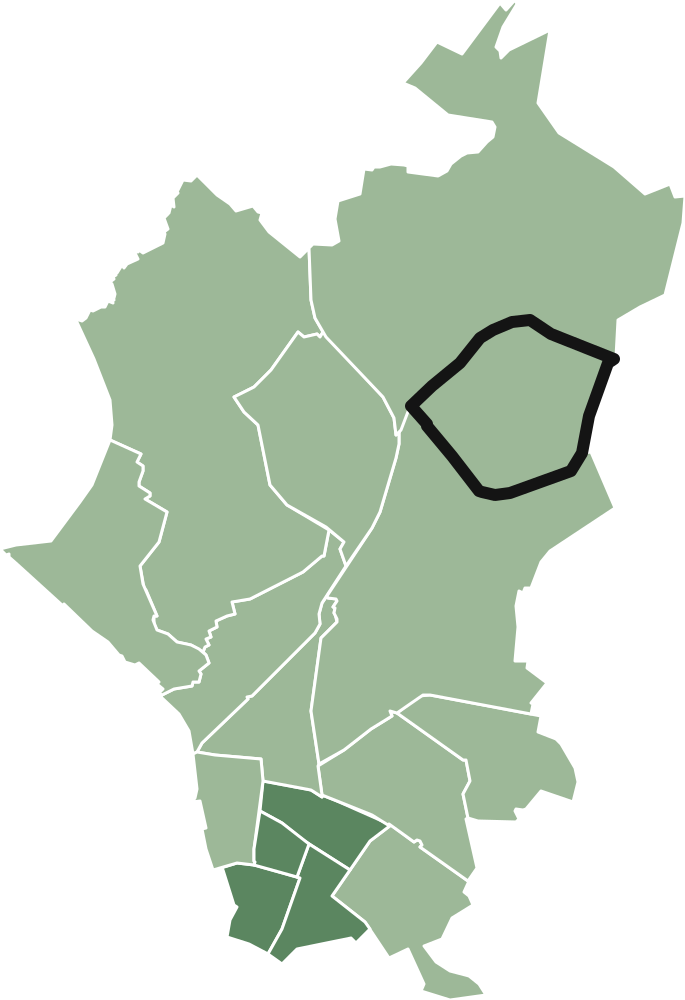
- 0 to 25
- 26 to 50
- 51 to 75
- 76 to 100
- Karow: thick outline
- no value
Noise and air
Traffic noise in Karow averages 51.8 dB. That is louder than in 85% of Berlin's Kieze.
Average noise level over day, evening and night (L_DEN), Strategic Noise Map 2022. Source: Berlin Environmental Atlas.
| Value | Karow | typical Kiez |
|---|---|---|
| High air pollution, % of sub-areas Sub-areas (planning areas) with high air pollution, Environmental Justice Atlas 2023 | 0 less polluted | 60¹ |
| Most common noise class, class Most common class of the noise map across the sub-areas | medium | medium |
More values
typical Kiez = median of the 143 Kieze
- High air pollution, % of sub-areas 0
Sub-areas (planning areas) with high air pollution, Environmental Justice Atlas 2023
typical Kiez: 60¹ less polluted
- Most common noise class, class medium
Most common class of the noise map across the sub-areas
typical Kiez: medium
¹ High air pollution: typical Kiez = median of the 87 Kieze with high air pollution.
| Value | Karow | Berlin median | Berlin, median |
|---|---|---|---|
| Traffic noise | 51.8 dB | 49.1 dB | 49.1 dB |
Green space and heat
Parks and green spaces cover 4.6% of area in Karow. That is less green than in 54% of Berlin's Kieze.
Public parks and green spaces. Source: Berlin green space register.
| Value | Karow | typical Kiez |
|---|---|---|
| Little green space near homes, % of sub-areas Sub-areas (planning areas) that the Berlin Senate rates as poorly supplied with green space near homes | 0 better supplied | 50¹ |
| Green space provision according to the Senate, class Most common rating of how well people in the sub-areas are supplied with green space near their homes | good | good |
More values
typical Kiez = median of the 143 Kieze
- Little green space near homes, % of sub-areas 0
Sub-areas (planning areas) that the Berlin Senate rates as poorly supplied with green space near homes
typical Kiez: 50¹ better supplied
- Green space provision according to the Senate, class good
Most common rating of how well people in the sub-areas are supplied with green space near their homes
typical Kiez: good
¹ Little green space near homes: typical Kiez = median of the 60 Kieze that have poorly supplied sub-areas.
| Value | Karow | Berlin median | Berlin, median |
|---|---|---|---|
| Parks and green spaces | 4.6% of area | 5.3% of area | 5.3% of area |
| Perceived temperature in the afternoon | 38.2 °C | 35.7 °C | 35.7 °C |
Housing and rent
Existing tenants in Karow pay 8.14 €/m² in net rent. That is more expensive than in 72% of Berlin's Kieze.
Net rent in existing rental contracts. Source: Census 2022.
| Value | Karow | typical Kiez |
|---|---|---|
| Old buildings, % of homes Homes in buildings built before 1949 | 15 | 35 |
| Rent protection areas (Milieuschutz), % of area Area in Milieuschutz zones, where renovations and the conversion of rentals into owned flats need approval | 0 | 23¹ |
More values
typical Kiez = median of the 143 Kieze
- Old buildings, % of homes 15
Homes in buildings built before 1949
typical Kiez: 35
- Rent protection areas (Milieuschutz), % of area 0
Area in Milieuschutz zones, where renovations and the conversion of rentals into owned flats need approval
typical Kiez: 23¹
¹ Rent protection areas (Milieuschutz): typical Kiez = median of the 64 Kieze with area in Milieuschutz zones.
| Value | Karow | Berlin median | Berlin, median |
|---|---|---|---|
| Rent in existing contracts | 8.14 €/m² | 7.62 €/m² | 7.62 €/m² |
Getting around
Karow has 6.5 stops per square kilometre. That is fewer than in 83% of Berlin's Kieze.
Stops for U-Bahn, S-Bahn, tram and bus. Source: OpenStreetMap.
| Value | Karow | typical Kiez |
|---|---|---|
| Stop within 400 m, % of residents Residents who live no more than 400 metres from the nearest stop | 86 farther away | 98 |
| U-Bahn and S-Bahn stations | 1 | 1 |
More values
The number covers the whole area. Larger areas often have more.
typical Kiez = median of the 143 Kieze
- Stop within 400 m, % of residents 86
Residents who live no more than 400 metres from the nearest stop
typical Kiez: 98 farther away
- U-Bahn and S-Bahn stations 1
typical Kiez: 1
| Value | Karow | Berlin median | Berlin, median |
|---|---|---|---|
| Public transport stops | 6.5 per km² | 12.0 per km² | 12.0 per km² |
Shopping, day care, culture
Karow has 5.0 food shops per 10,000 residents. That is fewer than in 80% of Berlin's Kieze.
Supermarkets, discounters and other food shops. Source: OpenStreetMap.
| Value | Karow | typical Kiez |
|---|---|---|
| Pharmacies | 1.5 | 1.6 |
| Day care centres (Kitas) Day care centres | 7.9 | 6.9 |
| Schools | 2.0 | 2.3 |
| Cultural venues Museums, theatres, cinemas, libraries, galleries, clubs and community arts centres | 0.5 | 1.5 |
More values
per 10,000 people
typical Kiez = median of the 143 Kieze
- Pharmacies 1.5
typical Kiez: 1.6
- Day care centres (Kitas) 7.9
Day care centres
typical Kiez: 6.9
- Schools 2.0
typical Kiez: 2.3
- Cultural venues 0.5
Museums, theatres, cinemas, libraries, galleries, clubs and community arts centres
typical Kiez: 1.5
| Value | Karow | Berlin median | Berlin, median |
|---|---|---|---|
| Food shops | 5.0 per 10,000 people | 7.9 per 10,000 people | 7.9 per 10,000 people |
People
Karow has 3,054 residents per square kilometre. That is fewer than in 78% of Berlin's Kieze.
Registered residents, as of the end of 2024. Source: Statistical Office Berlin-Brandenburg.
| Value | Karow | typical Kiez |
|---|---|---|
| Recorded crime, index, weighted cases per 100,000 people Frequency rate per planning region (Bezirksregion), not per address. The value relates recorded cases to registered residents and does not measure personal risk. Places with many tourists or commuters look worse as a result, and unreported crime is missing. The value is not a safety ranking. | 443 | 951 |
| Social situation, class Most common level of the sub-areas in the Senate's Social Urban Development Monitoring 2025 | high | medium |
More values
typical Kiez = median of the 143 Kieze
- Recorded crime, index, weighted cases per 100,000 people 443
Frequency rate per planning region (Bezirksregion), not per address.
What does the value mean?
The value relates recorded cases to registered residents and does not measure personal risk. Places with many tourists or commuters look worse as a result, and unreported crime is missing. The value is not a safety ranking.
typical Kiez: 951
- Social situation, class high
Most common level of the sub-areas in the Senate's Social Urban Development Monitoring 2025
typical Kiez: medium
| Value | Karow | Berlin median | Berlin, median |
|---|---|---|---|
| Population density | 3,054 people per km² | 6,084 people per km² | 6,084 people per km² |
Elections since 2016
In the 2025 Bundestag election, the AfD came first in Karow with 26%. In all of Berlin it won 15%, and Die Linke came first there with 20%. Since 2017 the AfD has gained 6 percentage points here, and the CDU has lost 5.
Each small chart shows one party, all on the same scale. Results for single Kieze start in 2016, for the Bundestag in 2017.
| Party | 2017 | 2021 | 2025 |
|---|---|---|---|
| AfD | 20% (12%) | 24% (9%) | 26% (15%) |
| CDU | 25% (23%) | 25% (17%) | 20% (18%) |
| Die Linke | 20% (19%) | 10% (12%) | 15% (20%) |
| FDP | 8% (9%) | 4% (8%) | – |
| GRÜNE | 6% (13%) | 12% (22%) | 10% (17%) |
| SPD | 15% (18%) | 14% (22%) | 12% (15%) |
| BSW | – | – | 9% (7%) |
Neighbours and similar Kieze
“Compare” sets every chapter on this page against the chosen Kiez. The name opens its own page.
Similar
Kieze with similar values in the five areas of the Kiez score
The Kiez score at a glance
Karow scores 41 out of 100 points and ranks 73 of 143 Kieze. Each row shows one area, more points are better. The ring is the Berlin median.
Culture and recorded crime do not count towards the Kiez score. Crime is therefore shown separately and without a rating.
| Area | Karow | Berlin median | Difference |
|---|---|---|---|
| Overall score | 41 | 41 | ±0 |
| Quiet & air | 71 | 64 | +7 |
| Green & heat | 66 | 55 | +11 |
| Mobility | 25 | 26 | −1 |
| Local amenities | 43 | 53 | −10 |
| Tenant protection | 0 | 0 | ±0 |
| Culture | 7 | 42 | −35 |
| Recorded crime | 10 | 45 | −35 |
Frequently asked questions
›How loud is it in the Kiez Karow?
Moderately loud. Two thirds of the subareas are in the noise class medium, one third in the class high. This means traffic noise from roads, rail and aircraft, averaged over day, evening and night. The navigator.berlin Quiet & air score combines noise and air. There the Kiez gets 71 of 100 points, rank 48 of 143 Kieze. That is more than the average of the Kieze in its district. Source: Noise pollution 2023, as of January 2024.
›How up to date is the noise data for Karow?
The noise classes date from January 2024. The Senate has the noise map recalculated every five years, in line with the EU cycle.
›How well is the Kiez Karow supplied with green space?
Good, according to the Senate. The whole Kiez is rated as well served with green space. The Senate measures how much public green space per person lies near homes. The navigator.berlin Green & heat score is a different measure. It combines green space and heat. There the Kiez gets 66 of 100 points, joint rank 35 of 143 Kieze. That is more than the average of the Kieze in its district. Source: Green space provision 2023, as of January 2024.
›How well is the Kiez Karow served by bus and train?
The stop network here is moderately dense, in the Berlin mid-range. There are 6.5 stops per square kilometre. The Kiez has one S-Bahn station and 42 bus stops, but no U-Bahn station and no tram stop. In the navigator.berlin Mobility score, the Kiez gets 25 of 100 points, rank 75 of 143 Kieze. That is less than the average of the Kieze in its district. Source: Public transport stops (BVG + S-Bahn), as of May 2026.
›Does navigator.berlin rate residential areas as good or bad?
No. We show ratings from official data, such as the Mietspiegel residential area type, the social monitoring or the standard land value. These ratings describe a place; they do not judge it. We do not use labels such as “popular Kiez” or “good district”.
›How much tenant protection is there in Karow?
In the navigator.berlin Tenant protection score, the Kiez gets 0 of 100 points, joint rank 60 of 143 Kieze. That is less than the average of the Kieze in its district. The score measures how much of the area is under Milieuschutz. Milieuschutz is meant to protect tenants from displacement.
›How hot does the Kiez Karow get on hot days?
On hot days it gets warm here, but not extreme: the perceived temperature averages 38.2 degrees. The perceived temperature (PET) takes sun, wind and humidity into account. Source: Perceived temperature 2022, as of June 2024.